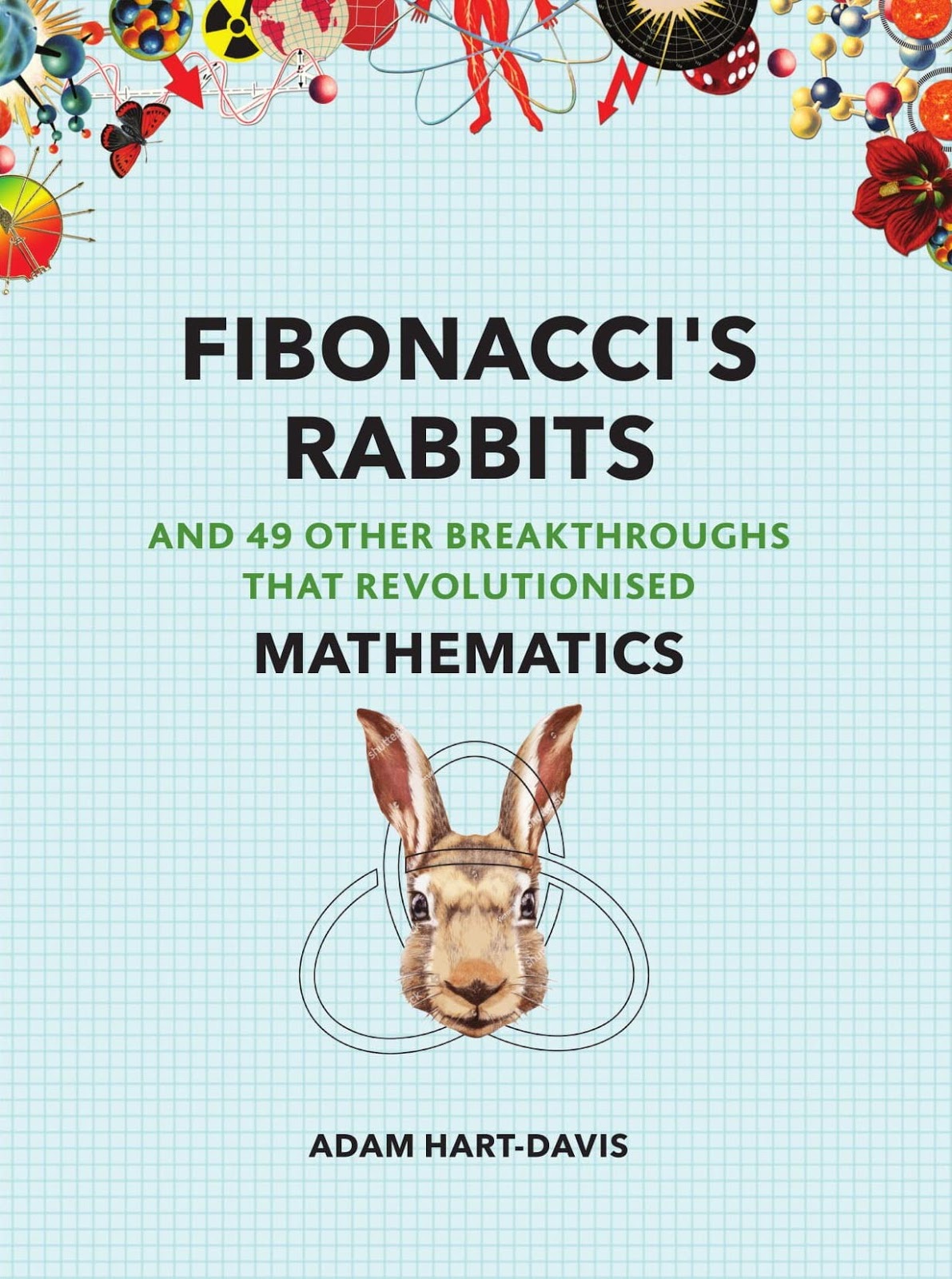
Fibonacci's Rabbits - Adam Hart-Davis ****

I'm not a great fan of '50 things' type books, though they seem eternally popular, but as was the case with Adam Hart-Davis's psychology title in the same series (Pavlov's Dog), I was pleasantly surprised, in part because the topic was well-suited to the format, and in part because the Hart-Davis has three pages of text to play with rather than just an illustrated spread.

After giving us some foundational and historical aspects of mathematics, from the origins of base 10 and base 60 to pi and zero, Hart Davis gets onto more meaty material, ranging through everything from chaos theory to game theory, plus some lighter weight but enjoyable mathematical deviations such as the Fibonacci sequence rabbits in the book's title, or the strange 3D shapes known as scutoids. It's all easy reading - no mathematical experience required - and a good way to get a feel for the way that maths is so much more than arithmetic, geometry and algebra.

One minor irritation is the way that every item is titled as a question, some of which aren't actually answered in the text. So, for example, we get 'How big is infinity?', which gives us a quick tour of ancient Greeks, Galileo and Cantor, but (perhaps thankfully) doesn't actually attempt to address the question. This entry also demonstrated why this format has its limits on a big topic (no pun intended) like infinity. Hart-Davis mentions, for example, Hilbert's Hotel - but doesn't take the reader through what's involved, so we just get a vague statement that Hilbert used a series of ingenious proofs to show that despite the infinite set of rooms being full, an infinite set of extra guests can be accommodated. There's no point saying this unless it's opened up in a bit more detail.

Despite a few issues with generalisation like this, though, it's a readable and enjoyable exploration for the key aspects of mathematics, plus some of the fun bits.

Paperback:   
Using these links earns us commission at no cost to you
Review by Brian Clegg

Comments

Post a Comment

Popular posts from this blog

The Infinite Alphabet - Cesar Hidalgo ****

Although taking a very new approach, this book by a physicist working in economics made me nostalgic for the business books of the 1980s. More on why in a moment, but Cesar Hidalgo sets out to explain how it is knowledge - how it is developed, how it is managed and forgotten - that makes the difference between success and failure. When I worked for a corporate in the 1980s I was very taken with Tom Peters' business books such of In Search of Excellence (with Robert Waterman), which described what made it possible for some companies to thrive and become huge while others failed. (It's interesting to look back to see a balance amongst the companies Peters thought were excellent, with successes such as Walmart and Intel, and failures such as Wang and Kodak.) In a similar way, Hidalgo uses case studies of successes and failures for both businesses and countries in making effective use of knowledge to drive economic success. When I read a Tom Peters book I was inspired and fired up...

God: the Science, the Evidence - Michel-Yves Bolloré and Olivier Bonnassies ***

This is, to say the least, an oddity, but a fascinating one. A translation of a French bestseller, it aims to put forward an examination of the scientific evidence for the existence of a deity… and various other things, as this is a very oddly structured book (more on that in a moment). In The God Delusion , Richard Dawkins suggested that we should treat the existence of God as a scientific claim, which is exactly what the authors do reasonably well in the main part of the book. They argue that three pieces of scientific evidence in particular are supportive of the existence of a (generic) creator of the universe. These are that the universe had a beginning, the fine tuning of natural constants and the unlikeliness of life.  To support their evidence, Bolloré and Bonnassies give a reasonable introduction to thermodynamics and cosmology. They suggest that the expected heat death of the universe implies a beginning (for good thermodynamic reasons), and rightly give the impression tha...

The War on Science - Lawrence Krauss (Ed.) ****

At first glance this might appear to be yet another book on how to deal with climate change deniers and the like, such as How to Talk to a Science Denier.   It is, however, a much more significant book because it addresses the way that universities, government and pressure groups have attempted to undermine the scientific process. Conceptually I would give it five stars, but it's quite heavy going because it's a collection of around 18 essays by different academics, with many going over the same ground, so there is a lot of repetition. Even so, it's an important book. There are a few well-known names here - editor Lawrence Krauss, Richard Dawkins and Steven Pinker - but also a range of scientists (with a few philosophers) explaining how science is being damaged in academia by unscientific ideas. Many of the issues apply to other disciplines as well, but this is specifically about the impact on science, and particularly important there because of the damage it has been doing...

