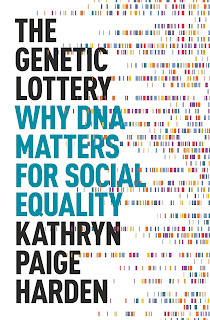
The Genetic Lottery - Kathryn Paige Harden ****

Sometimes you get hold of a book, then keep putting off reading it, because it seems like it's going to be hard work. That's what I did with The Genetic Lottery - in a sense I was right. It could have been more accessible in its writing style, but where I was expecting a woke, knee-jerk response to genetics and social equality, what we get instead is a well-reasoned argument for taking a different approach, combined with more in-depth explanation of the traps it is possible to fall into when dealing with the influence of genes on cognitive ability, earning etc. - and how to avoid them.

Kathryn Paige Harden has to tread carefully. Any mention of linking genetics and ability is liable to face an instant accusation of resorting Galtonesque eugenics. However, Harden espouses what she calls anti-eugenics. It is not enough, she suggests to be genetics blind. If we really want equity of opportunity, we need to try to level out genetic favourability just as much as we should try to deal with the impact of social deprivation on opportunity.

Harden shows in some detail how it is possible to discover the level of genetic contribution to anything from height to educational attainment. And though this may well only contribute 10 to 20 per cent of the difference, it has a bigger influence than does, for example, how rich mummy and daddy are. She also makes it very clear that this has nothing to do with race. Although there are some relatively minor genetic differences between groups of people which tend to be labelled as races (the concept of race itself is totally non-scientific), they are trivial compared with genetic differences where these labels don't apply.

Although Harden writes in quite a personal fashion, I did find the text difficult to read - it works around points at length, often without really coming down to a clear conclusion. The reader gets a feeling of where she is going, but it's hard to pin down clear ways forward. She tells us, for example, of the uselessness of a communist regime's levelling down approach to dealing with inequity - but doesn't really give a practical path for doing anything in modern Western society, particularly in the US, with the exception of overhauling its ridiculous healthcare system.

Harden often uses religious examples or metaphors, and to some extent, this book seems like the John the Baptist of the genetic lottery and how to deal with it - it lays some of the groundwork, but doesn't really tell us how to get there. Like many books on climate change, it's a lot better on the problem than the solution. Even so, it is a real eye-opener and an important book. For too long we have assumed that if we could fix the unfairness in the system, we would be fine having a hierarchy based on genetic ability - reward based on talent. Harden underlines the unfairness of this approach, while still recognising that we want the selection of people doing a job like an airline pilot or surgeon to be based on what they can deliver, rather than equity of outcome. It may be that we can never square this particular circle. But it's a topic that benefits from discussion.

Hardback: 
Bookshop.org


Kindle 
Using these links earns us commission at no cost to you
Review by Brian Clegg

Comments

Popular posts from this blog

The Infinite Alphabet - Cesar Hidalgo ****

Although taking a very new approach, this book by a physicist working in economics made me nostalgic for the business books of the 1980s. More on why in a moment, but Cesar Hidalgo sets out to explain how it is knowledge - how it is developed, how it is managed and forgotten - that makes the difference between success and failure. When I worked for a corporate in the 1980s I was very taken with Tom Peters' business books such of In Search of Excellence (with Robert Waterman), which described what made it possible for some companies to thrive and become huge while others failed. (It's interesting to look back to see a balance amongst the companies Peters thought were excellent, with successes such as Walmart and Intel, and failures such as Wang and Kodak.) In a similar way, Hidalgo uses case studies of successes and failures for both businesses and countries in making effective use of knowledge to drive economic success. When I read a Tom Peters book I was inspired and fired up...

God: the Science, the Evidence - Michel-Yves Bolloré and Olivier Bonnassies ***

This is, to say the least, an oddity, but a fascinating one. A translation of a French bestseller, it aims to put forward an examination of the scientific evidence for the existence of a deity… and various other things, as this is a very oddly structured book (more on that in a moment). In The God Delusion , Richard Dawkins suggested that we should treat the existence of God as a scientific claim, which is exactly what the authors do reasonably well in the main part of the book. They argue that three pieces of scientific evidence in particular are supportive of the existence of a (generic) creator of the universe. These are that the universe had a beginning, the fine tuning of natural constants and the unlikeliness of life.  To support their evidence, Bolloré and Bonnassies give a reasonable introduction to thermodynamics and cosmology. They suggest that the expected heat death of the universe implies a beginning (for good thermodynamic reasons), and rightly give the impression tha...

The War on Science - Lawrence Krauss (Ed.) ****

At first glance this might appear to be yet another book on how to deal with climate change deniers and the like, such as How to Talk to a Science Denier.   It is, however, a much more significant book because it addresses the way that universities, government and pressure groups have attempted to undermine the scientific process. Conceptually I would give it five stars, but it's quite heavy going because it's a collection of around 18 essays by different academics, with many going over the same ground, so there is a lot of repetition. Even so, it's an important book. There are a few well-known names here - editor Lawrence Krauss, Richard Dawkins and Steven Pinker - but also a range of scientists (with a few philosophers) explaining how science is being damaged in academia by unscientific ideas. Many of the issues apply to other disciplines as well, but this is specifically about the impact on science, and particularly important there because of the damage it has been doing...

