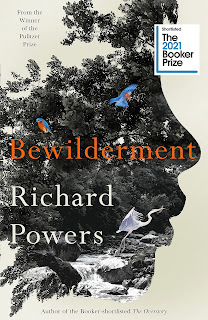
Bewilderment (SF) - Richard Powers ****

Generally speaking, I avoid anything listed for the Booker Prize as being too worthy and pretentious to be bothered with, but I'd heard good things about Bewilderment, and I have found in the past that genre books that manage to get past the literati (Wolf Hall, for example) are far better than the average entry.

The publisher would probably disagree, but the reality is that Bewilderment is science fiction. I wondered to start with if Richard Powers was dealing more in Lab Lit - fiction with a scientific context but where the science isn't the driver in how people's lives are changed - but this is pretty solid SF. Clearly the book is strongly influenced by that SF classic Flowers for Algernon - in fact, Powers does a couple of open hat tips in its direction. Although Bewilderment isn't as ground-breaking as Flowers, it follows the model of a person's brain being changed by science to deal with an issue, but here it's an emotional problem rather than an intellectual one.

There is also a second level of SF content - one of the two main characters is an astrobiologist, and the very short segments of the book (you couldn't call them chapters, but they make it easy to 'just read one more') are interspersed with 'visits' to imaginary other planets 'taken' by the character with his son, Robin, who is the one who undergoes the brain treatment that seems to mystically link him to aspects of his dead mother.

The book is genuinely engaging and we feel for father and son as they struggle with the realities of life. The SF concept is interesting and the scientific detail well-handled without it getting in the way.

I only have two small issues with the book. One is that the pretentiousness required to make the shortlist creeps in a bit. The dialogue of the boy and his mother is all in italics without speech marks. This makes for poor readability and provides no benefit for the narrative - it's just showing off. And the environmental context is very heavy handed. Not only is the boy's heroine a weakly disguised Greta Thunberg, but the real threat we face in climate change is presented in the pure doom terms typical of children - acceptable in the child character, but not the supposed scientist father. It simply doesn't reflect the real science of climate change in the way that the astrobiology parts do.

Overall, an interesting and enjoyable book. I find it entertaining that it's apparently a bestseller in the 'metaphysical and visionary' category: this underestimates its value. What Powers does here is what SF does far better than conventional literary fiction - explore what it is to be human by using hypothetical developments in science and technology to imagine how human beings would react to them. Bewilderment does this very well.

Hardback: 
Bookshop.org


Kindle 
Using these links earns us commission at no cost to you
Review by Brian Clegg

Comments

Popular posts from this blog

Luna: Moon Rising (SF) - Ian McDonald ****

I'm not the natural audience for this book. Game of Thrones l eaves me cold - and it's hard not to feel the influence of GoT (and a whole lot of Dune )   underneath a veneer of science fiction and the trappings of a South American drug cartel in the cod-medieval family power battles and chivalric details. There are even dragons (of a sort). I'd be really sad if the future did involve this sort of throwback feudalism. However, remarkably, despite this I found Luna: Moon Rising kept me engaged. The fact is that Ian McDonald can put together a good plot with intricate machinations, which is enough to carry the reader through what can be a bewildering collection of characters. The two page scene-setter saying who did what to whom at the start was useful, but I could have done with family trees for the main family as I was constantly forgetting who was who - especially easy as McDonald endows many families with characters with the same first initial (e.g. Ariel and Al...

Adventures of a Computational Explorer - Stephen Wolfram ***

Stephen Wolfram, the man behind the scientist's mathematical tool of choice, Mathematica, plus a whole host of other software products, including the uncanny Wolfram Alpha knowledge engine, is undoubtedly a genius of the first order. In this book, we get an uncensored excursion into the mind of genius - which is, without doubt, a fascinating prospect. The book consists of a collection of essays and speeches that Wolfram has produced over the last ten to fifteen years, covering an eclectic range of topics. Like all such collections, the result is something that lacks the coherence of a book with a narrative that runs through it, inevitably introducing a degree of repetition and a mix of interesting and not-so-interesting topics - but there's likely to be something to catch the attention anyone who is into computing or mathematics. One of the most interesting pieces is the opening one, where Wolfram describes being a consultant on the SF movie Arrival. He seems to hav...

The AI Paradox - Virginia Dignum ****

This is a really important book in the way that Virginia Dignum highlights various ways we can misunderstand AI and its abilities using a series of paradoxes. However, I need to say up front that I'm giving it four stars for the ideas: unfortunately the writing is not great. It reads more like a government report than anything vaguely readable - it really should have co-authored with a professional writer to make it accessible. Even so, I'm recommending it: like some government reports it's significant enough to make it necessary to wade through the bureaucrat speak. Why paradoxes? Dignum identifies two ways we can think about paradoxes (oddly I wrote about paradoxes recently , but with three definitions): a logical paradox such as 'this statement is false', or a paradoxical truth such as 'less is more' - the second of which seems a better to fit to the use here.  We are then presented with eight paradoxes, each of which gives some insights into aspects of t...

