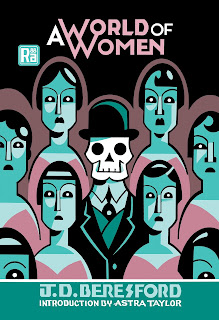
A World of Women (SF) - J. D. Beresford ****

The MIT Press series 'Radium Age' introduces us to science fiction from the sometimes forgotten period between pioneers such as Wells and Verne and the pulp era. This was relatively easy to do with the introductory collection of short stories, Voices from the Radium Age, as the SF short story was already a fairly polished form by then, but many of the novels of the period were turgid - finding one that is both illustrative and still readable must have been something of a challenge. Although A World of Women has its tedious passages, it is nonetheless an eye-opener.

Of course, the editors must have thought they had struck gold when they saw what it featured - a pandemic (described as a plague) that starts in China then spreads relentlessly around the world. There is particular resonance early on with Covid, when John Davys Beresford gives us a debate between the economics of staying open to the world and the potential benefit of closing borders immediately. But there is one huge difference with a real pandemic - this plague is almost always deadly for men, but spares most women.

This gives Beresford the opportunity in this his second novel, dating back to 1913 (he would go on to write until the 1940s) to pull apart the stuffy attitudes of Edwardian society and to consider ways in which he thought women would do things differently, on top of the usual post-apocalyptic 'how will an industrialised society survive without any of the usual services?' question. We see many dying of starvation before a return to the land and a medieval-level agricultural existence becomes common.  

There are some problems. Apart from the boring bits of exposition, despite his relative modernity on such things as sex outside marriage, Beresford is mired in the antisemitism, and class and gender prejudices, of his age. He claims that in the new society the old ideas of class don't matter, describing titled ladies working in the fields alongside farmers' widows - yet his portrayal of the Goslings, the central family in the story, (the book was originally called The Goslings) is riddled with the author's casual disdain for the intelligence of the working class, and the idea that women would find it difficult to understand anything requiring logic, not helped by a painful attempt to spell out a cockneyish accent worthy of Dick van Dyke in the family's speech.

There's also a fudged ending that is distinctly uninspiring. However, this is a genuinely interesting SF novel with what was, for the period, particularly original thinking. It's a real asset to the series.

Paperback: 
Bookshop.org


Kindle 
Using these links earns us commission at no cost to you

Comments

Popular posts from this blog

The Infinite Alphabet - Cesar Hidalgo ****

Although taking a very new approach, this book by a physicist working in economics made me nostalgic for the business books of the 1980s. More on why in a moment, but Cesar Hidalgo sets out to explain how it is knowledge - how it is developed, how it is managed and forgotten - that makes the difference between success and failure. When I worked for a corporate in the 1980s I was very taken with Tom Peters' business books such of In Search of Excellence (with Robert Waterman), which described what made it possible for some companies to thrive and become huge while others failed. (It's interesting to look back to see a balance amongst the companies Peters thought were excellent, with successes such as Walmart and Intel, and failures such as Wang and Kodak.) In a similar way, Hidalgo uses case studies of successes and failures for both businesses and countries in making effective use of knowledge to drive economic success. When I read a Tom Peters book I was inspired and fired up...

God: the Science, the Evidence - Michel-Yves Bolloré and Olivier Bonnassies ***

This is, to say the least, an oddity, but a fascinating one. A translation of a French bestseller, it aims to put forward an examination of the scientific evidence for the existence of a deity… and various other things, as this is a very oddly structured book (more on that in a moment). In The God Delusion , Richard Dawkins suggested that we should treat the existence of God as a scientific claim, which is exactly what the authors do reasonably well in the main part of the book. They argue that three pieces of scientific evidence in particular are supportive of the existence of a (generic) creator of the universe. These are that the universe had a beginning, the fine tuning of natural constants and the unlikeliness of life.  To support their evidence, Bolloré and Bonnassies give a reasonable introduction to thermodynamics and cosmology. They suggest that the expected heat death of the universe implies a beginning (for good thermodynamic reasons), and rightly give the impression tha...

The War on Science - Lawrence Krauss (Ed.) ****

At first glance this might appear to be yet another book on how to deal with climate change deniers and the like, such as How to Talk to a Science Denier.   It is, however, a much more significant book because it addresses the way that universities, government and pressure groups have attempted to undermine the scientific process. Conceptually I would give it five stars, but it's quite heavy going because it's a collection of around 18 essays by different academics, with many going over the same ground, so there is a lot of repetition. Even so, it's an important book. There are a few well-known names here - editor Lawrence Krauss, Richard Dawkins and Steven Pinker - but also a range of scientists (with a few philosophers) explaining how science is being damaged in academia by unscientific ideas. Many of the issues apply to other disciplines as well, but this is specifically about the impact on science, and particularly important there because of the damage it has been doing...

