
Nothing gives an author a sinking feeling more than noticing that someone else has brought out a book on the same subject at more or less the same time – yet it happens all too frequently. It’s not some evil conspiracy (usually), but it is more a matter of the author searching for an idea that hasn’t been covered too much already and that seems to be timely, and producing a book that has immediate competitor. From the reviewer’s point of view, it’s quite different, of course. It’s rather handy to have something to use for direct comparison.
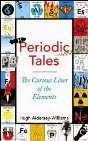
This rather lengthy introduction is to point out that we’ve only just reviewed a book on the chemical elements when along comes another, just like those famed London buses. Sam Kean’s The Disappearing Spoon was a big hit here, so it’s fascinating to be able to put Hugh Aldersey-Williams’ Periodic Tales alongside it. Periodic Tales is a chunky book that has a classy look and feel. Like Kean, Aldersey-Williams doesn’t go for the obvious and potentially tedious route of organizing the elements by the structure of the periodic table. Instead, each chapter dives around the table using various linking strategies. So we go from gold to platinum, palladium to iron and so on, in a first section loosely connected on the theme of ‘power’.
Straight away Aldersey-Williams demonstrates what he does best, taking us off on a little side story with gold, describing the solid gold lifesize statue of Kate Moss, Siren. The author muses that the statue must be hollow, as the artist wanted it to weigh the same as the model, around 50 kilograms, which is nowhere enough for a solid figure this size. Then he whips us off the the early days of gold, the conquistadores, the American gold rush and more. It can be a little exhausting – but you certainly get your money’s worth in this delightful trip.
I think Aldersley-Williams really triumphs when he has a go himself. His description of his attempt to get hold of homeopathic plutonium (sic) is hilarious, and his recreation of a medieval method of obtaining phosphorus from his own urine has a distinct and powerful alchemical quality. This is excellent stuff.
The only real problem with this book is it goes on too long. Of course he wants to get everything in (some admittedly in a rather cursory fashion), but in the end the reader starts to get element fatigue. I felt this with Kean’s book as well, but not as much. In the end, I found Kean’s writing style more approachable (though there is nothing wrong with Aldersley-Williams’ style) and The Disappearing Spoon, by giving us less, managed to give more in the form of a more readable book. It’s interesting that the BBC Radio 4 condensation of the book used a fusty, pernickety and slightly wry voice to read Periodic Tales. I think this tells you something about the way it reads.
Occasionally the author also a tendency to imbue situations (and elements) with a false significance. For example, we are told that when he worked with plutonium at Harwell as a summer job, ‘The aura of power surrounding the element was made apparent when, as a condition of employment, I had to sign the Official Secrets Act.’ I really don’t think this had anything to do with an ‘aura of power’ surrounding plutonium. I had to sign the Official Secret Act when I did some work at the Met Office – it just reflects the connection with the Ministry of Defence.
This is a very good book, and many people will get a lot of enjoyment from it. It goes into more of the art and cultural implications of the elements than does The Disappearing Spoon, which will appeal to readers who are less comfortable with science. Reflecting the authors’ nationalities, this is a much more English book than Kean’s, and that will make it appeal to many readers above the competition. But I’m afraid, for me, it does come a very honourable second.
Hardback: 

Kindle:
Using these links earns us commission at no cost to you
Using these links earns us commission at no cost to you
Review by Brian Clegg
Comments
Post a Comment