
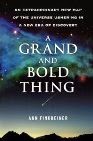
 Over the summer I tend to cut back on reading popular science so I can come back to the reviewing refreshed – and what a refreshing book to come back with. Ann Finkbeiner’s account of the making of the Sloan Digital Sky Survey was wonderful – without doubt the best popular science book I’ve read so far in 2010.
It tells the story of the establishment of a scientific project – the mapping of a whole large section of sky in detail, providing digital information that would allow for pretty pictures like Google Sky, but more of interest to the scientists involved would enable comparison of galaxies, quasars, stars and more across a swathe of sky using digital data that including vast amounts of spectrographic analysis, images using different coloured filters and more. In effect, with the results of the survey – freely available to anyone – it’s possible for astronomers to work statistically, to make the sort of comparisons that ‘real’ scientists can do with repeated experiments, but has not been possible for astronomy before. As well as providing information that was expected, the Sloan was soon also making revelations that were never dreamed of when the survey was conceived. An astronomer could spend her entire career mining knowledge from the Sloan data without ever going near a telescope. Purists may wince at this – but in terms of our knowledge of the universe it is amazing.
However, as Finkbeiner shows us with excellent portraits of the people and processes involved, this huge success of a scientific project was no easy ride. There were difficult personalities and technical disasters. Mirrors cracked, one of the two telescopes proved totally unsuitable for the job (luckily they found a replacement in an existing telescope that wasn’t doing much as it was in a city and practically useless). To the outside observer who has any experience of project management is, frankly amateurism when it comes to getting the project together. There were lots of technical experts who knew exactly what they wanted – but no one making sure things happened at the right place in the right order to succeed.
It’s a dramatic story of a project that could easily have been cancelled, of remarkable feats of technology and ingenuity – and of the drive that makes people want to observe the universe. Finkbeiner really puts us in the heart of it. We live the experience with those astronomers and technicians. It’s a beautifully crafted book from an author who really knows how to tell a story.
Just three small gripes. Finkbeiner tends to switch between the past and present tense too often, sometimes mid-paragraph, and this can read a little oddly. The last couple of chapters seem a little rushed. They’ve done what they set out to do, now we’ll wrap it up – it feels slightly anti-climactic. And there are no pictures – none at all. I know what a pain it is to get illustrations together (and the poor author usually has to pay for them), but it seemed strange in a book so focussed on people and on producing images of the sky that we didn’t have photos of those people, the telescope or any of the output of the survey.
But these are minor niggles indeed. This is a brilliant book that captures the reality of getting a scientific project together. It’s hugely readable and highly recommended.
Hardback: 

Using these links earns us commission at no cost to you
Using these links earns us commission at no cost to you
Review by Brian Clegg
Comments
Post a Comment