
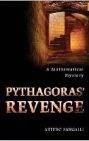
 It’s unusual for us to feature a fiction book in our main reviews section. Pythagoras’ Revenge is a novel that is designed to get across mathematical ideas in a more approachable way. It scores the rather unusual 3.5 stars – because this is a book that is 2/3 good and 1/3 bad.
Let’s start with the good. The concept really works. I read a lot of popular science books and have to read a fiction book about one every third title just to keep my enthusiasm up. Fiction usually grabs the attention better than an popular science book, however well written, and I found that I shot through Arturo Sangalli’s book significantly faster than I would a normal popular science title, because I wanted to read on.
What’s more, the maths is fine – it’s pitched at the right sort of level to interest the general reader without being too painful. For those with a more heavy duty interest, there are one or two proofs in appendices. A lot of the maths is from ancient Greece, and as befits what can, with one hat on, be seen as a popular maths book, there’s a good selection of history and context for the Pythagoreans as well.
But then we come to the 1/3 that’s bad. As a novel, I’m afraid, it’s pretty terrible. It’s not really possible to identify who the main protagonist(s) are, and we don’t care about any of the characters. Although there is a little Da Vinci Code style puzzle, it isn’t particularly interesting, and it’s very much presented as: ‘here’s a puzzle, oh, it could be that, okay, we’ve solved it.’ There’s no real tension. The central plot line involving possible reincarnation stretches disbelief without any real reward for doing so. And, perhaps worst of all, it doesn’t have the proper flow of a novel. There are several instances where the voice suddenly goes from historic narration to simple fact telling. So we hear about something happening in Pythagoras’ time… then suddenly there’s a few pages of pure maths exposition that could have come from any popular maths book, with no sense that the characters are saying or thinking what we’re told. It just plonks in.
However, I think it’s a very brave attempt, and shows that this really is a way of getting across science that can work – and would work even better if it was framed in a decently written novel. I said I’d hurried through because I wanted to read on. In part this was because I was rushing through some of the more excruciating storyline, but it also was because the story form gives a natural inclination to want to read more. Human beings are story making animals, and this book shows that there is an opportunity to make use of this approach in the field. A fascinating attempt.
Paperback: 

Using these links earns us commission at no cost to you
Review by Brian Clegg
Comments
Post a Comment